Showing posts with label Comedy. Show all posts

Wednesday, September 18, 2013

Entry 123: "The Monster X Strikes Back/Attack of the G8 Summit" (2008)


The Monster X Strikes Back/Attack of the G8 Summit

Dear Internet,

                Now, I on the right footing by watching the correct film today.  "The Monster X Strikes Back/Attack of the G8 Summit" is something of a sequel to the original movie.  I say somewhat because the only thing that the two films have in common is the shared monster Guilala.  Beyond that, there is next to no continuity between the two films.  Short of one joke about a Chinese knockoff spaceship named after the ship found in the first film, the monster is the only similarity that the two films have.  The second film also flips the genre it aims for completely upside down.  The original film was meant to be a drama, although how well it meant that goal can be questioned easily.  The second film is a comedy foremost with some political satire heaved heavily on the side.

                The film begins with the G* Summit being held in Japan.  Eight heads of countries have come together to discuss a number of pressing world issues.  As the group continues their discussions, an unidentified object crashes into Sapporo in northern Japan.  From the fiery carnage, Guilala emerges and brings death and destruction to the city.  The eight take it upon themselves to rid the world of Guilala so that none shall live in terror and that their ratings in the polls will go up.  Meanwhile, two Japanese journalists stumble upon a secret cult of worshipers dancing for their ancient god, Take-Majin.  As they push their inquiry further, they find out that it was foretold since long ago that Guilala was to invade Earth.  Humans would be unable to stop the creature.  Only the god Take-Majin could stop the extraterrestrial monstrosity.  The only problem is that the hero-god is nowhere to be seen in mankind's darkest hour.  Will he appear in time to save us?
The chicken from outer space comes back.

                I have probably written a more dramatic summary than any moment of the film itself.  This is because the film takes itself very lightly.  It is a comedy first and a monster film second.  The center of the film's comedy stems from the antics of the G8 group.  Each of the world leaders is an overly stereotypical cartoon character.  The leader of France is a womanizer who ignores his recent marriage.  The president of the USA is an idiot that cares more about his chances of being reelected than stopping the monster.  The Russian leader utilizes spy tactics to get the job done.  So on and so on, the film lays on these stereotypes to make the audience laugh.  It works quite well because the film does not take any sort of serious jab at anyone in particular.  Even the prime minister of Japan gets made fun of, having to run off to the bathroom constantly throughout the film due to indigestion.

                Beyond the comedy found in the war room, the film makes sure to carry over the silly shenanigans to the Guilala scenes.  The Japanese are the first who attempt to combat the creature by aiming a high powered missile straight at the creature.  This ends up being a poor idea.  Guilala catches the missile before it makes contact and eats the weapon hungrily.  After this, the various other world leaders try one after the other to destroy the beast.  Each manner reflects the comical stereotypes of each country.  I will not ruin any sort of surprises because the effect and failure of each one is a great punch line to each joke.

                There is one major problem with the film.  It stems from the film's subplot or side-plot.  The two journalists take a considerable amount of screen time thought the film.  They find the secret shrine, interact with the mysterious villagers, and find out about Take-Majin.  It all adds up to a good level of exposition to let Take-Maijin appear from out of nowhere.  However, despite their importance to generating information so that the audience can see how the day will truly be saved, they do not really do anything that affects the plot.  Sure, they eventually join the ritual dance, but their dancing is not made clear to have been the tipping point to getting Taka-Majin to appear.  For all we know, the ritual dance would have summoned the hero-god without the help of the two journalists.  They are only there as some sort of audience avatar to see the attack of Guilala from eyelevel.

                The inability of the journalists to make a bigger impact upon the story is not the biggest problem.  The problem is that it acts too much as a cold contrast to the comical half of the film.  Whenever the film covers the G8 Summit, laughter abounds.  There are sly jokes on the side that can be missed and other outlandish ones that are enough to bust a gut.  When the film turns to the reporters, there are no jokes or any sort of silliness.  The tone of the film shifts to being dramatic.  It is not overly dramatic to the point of being a joke itself, but the effect is that the film feels split in two.  It feels like the film was written by two different people.  One wrote the G8 Summit half and the other concentrated on the reporters.  At least it seems that the G8 writer had done the final fight between the two giants.  While the contrast between the two halves are never enough to feel like the film is a pendulum moving in great swings from one extreme to the other, it feels like more of a missed opportunity for there to have been humor in both halves.  The only joke that even comes from the journalist half has to do with the funny dance that is in the ritual.  This joke gets old fairly quickly because of how often it repeats.


                "The Monster X Strikes Back/Attack of the G8 Summit" is a good film if you want to watch a world political satire film.  It is a great film if you want a comedy about government incompetence.  It is an OK film to watch a monster destroy the countryside.  It is very enjoyable even without having watched the first film.  That last bit is probably the most important thing I can say about the film.  The sequel is not a parody of the first, despite the amount of available material to make fun of.  It is a general fun film.  Not even the stiff acting of the English speaking actors can detract from the film.  If anything, the stiff and poor acting makes the scenes funnier a la "The Skeleton of Cadavra," a parody film about bad horror films of old.

Yours in digital,
BeepBoop
P.S. Next is "The Sword with No Name" (2009).

Tuesday, August 6, 2013

Entry 103: "Singin' in the Rain" (1952)


Dear Internet,

                It has been a while since I covered a musical.  "K-On!" does not count despite what the tags claim.  The last one, and only one now that I think about it, was "Funny Girl" some 60 entries ago.  You can go back and reread that if you want.  I only wanted to point out how in frequent musicals seem to appear on this Backlog despite their importance in film and stage.  It is no secret that the American musical film has come and gone.  The golden age of musicals is long gone and will most likely not come back anytime soon.  The logistics and cost are a headache.  The audiences do not clamor for them like they once did.  A public that places less emphasis on lyrics and melody but want only as much as a "nice beat" do not want to watch a musical.  They want a drum line, not a song that can be sung in the shower or in the rain.

                "Singin' in the Rain" is a musical first and foremost.  Secondly, it is a story about the transition from silent films to talkies in the late 20s and early 30's.  Somewhere in all of that is a love story, but I suppose it is important, so I will talk about it.  Don Lockwood is a major actor in Hollywood who plays alongside leading lady, Lina Lamont.  Both are silent film stars, although Don has a skillful background in vaudeville and show business.  Not a successful one, but he has more experience in more types of entertainment than Lina.  After the premier of their newest film, the two along with a number of studio brass and employees watch a presentation of a short recording that makes use of synchronized audio alongside a projection.  Also at the party, Don meets with Kathy Selden, a dancer who had just snubbed Don when he tried to put the moves on her.  A few days pass, and Warner Brothers puts out "The Jazz Singer," the first fully talkie film.  It is a monster of a hit, and Don's studio decides to rework the film he is working on into a talkie as well.  The biggest problem is that Lina has got the voice of a screeching cat.  Reenter Kathy, who not only is able to help the situation but also works her way into Don's heart.

                Like I said before, "Singin' in the Rain" is a musical first.  There are a number of songs spread throughout, and dance numbers are just as plenty.  The extravagance of Broadway even gets a chance to be injected into the film.  From flashy costumes to giant scenes, the film knows how to splurge on the showmanship.  Unlike modern films that explicitly are aiming at making themselves look realistic and hope to draw in the viewer with promises of "immersion," golden era musicals were all about the glitz and glamour.  There was no attempt to make it seem like anything but a performance for the audience.  The fact that the film is a Hollywood depiction of Hollywood can be argued that it is just a self glorification, but that would be ignoring at how much the film pokes fun at itself.  Take the character of Lina.  She cannot act, sing, or dance at all.  The only reason she is even in show business is because of her looks.  The studio brass knows this and forbid her from talking to prevent the audience from finding out she has a voice as pleasant as a jingling tin can filled with nails.  On top of that is the fake relationship that the studio brass creates in the papers of her and Don.  If the film was a self glorification of Hollywood, it cannot poke fun at itself, lest it poke holes.

                The transition from silent films to talkies was one of the biggest transitions that the movie industry had to see through.   Next to it would have to be, in no particular order, the transition from monochrome to color, the Hays code, and possibly the introduction of 3D filming.  Time will tell if that last one makes any dent, but from a technical standpoint it is a hurdle that directors have to think about unless they want their films to look like generic paddleball-to-the-eye 3D movies.  The transition to talkies caused a number of actors to fade from the public view.  Once the audience learned that the person was just a pretty face, they had trouble getting roles and jobs on screen.  For those working behind the camera, numerous things had to be either reworked or had to be figured out to make the most of it.  "Singin'" points these out in the scenes where Lina fails to say her lines in the direction of the hidden microphone.  The problems are also showcased in the preview showing of Don and Lina's film.  The sound effects are too loud and the dialog is mostly mute and muffled.  The film makes humor on the topic while at the same time showcasing the real problems that an industry had to overcome.  Thankfully the invention of the boom-mic came along. 

                Another thing that the film addresses is the creation and execution of the over-dub.  Studios, for the longest time, would have the actor say their lines and act out their role for the majority of the film.  When it got time for them to sing, another person's voice would be recorded over their own.  Many musicals have such a difference in the voice change that it can be instantly noticeable.  Even if the voice is not over-dubbed by another person, the majority of musicals still need to be recorded again off screen.  Take the iconic scene of Don performing the titular song as he dances in the rain.  The man had a fever, was splashing loudly, and was far away from any sort of microphone that could resist the gallons of water that was pouring down.  If his voice could even be heard, it was most likely so distorted that it would have to be scrapped.  Only a sound booth recording dubbed over his performance could allow him to be heard.  Few films have live singing on scene that is used in the final cut.  The recent "Les Miserables" is one such film.  Thankfully, "Singin'" has excellent actors that do not need to be dubbed by other people.

                The most important aspect of the film has got to be the entertainment value.  As I said, musicals are generally meant to be seen as a performance rather than an immersion filled film.  The fact that people are spontaneously bursting out into song and dancing is a reality breaker.  So, the film has to entertain the audience with those reality breaking segments.  Between the titular song, "Make 'Em Laugh," and "Good Morning" the film knows what the audience wants and needs.  They want songs.  They need songs that can be sung, or at least hummed.  "Singin'" delivers this in stride.  The songs are catchy and have lasting ability.  On top of that, the choreography for the songs is able to express the joy that is in the characters.  There are a few tap-dancing segments that show off the main cast's ability while still breaking that wall of immersion.
That is a scarf right there that is over 30ft.

                What else can I say about "Singin' in the Rain" that has not already been said?  It has withstood the test of time easily.  There are plenty of lists that award it a top place or near to it.  It is a feel-good film.  There are no brooding harsh realities being thrown into the audience's face.  There is gleefulness abounding.  And that is a good thing.  While not escapism, "Singing'" is a brief sidestep that reminds the viewer of good old fashioned fun.  

Yours in digital,
BeepBoop

P.S. Next is the "Ghost in the Shell" film.

Friday, August 2, 2013

Entry 101: "K-On!!" Ep. 14-26 End


We can see here the show's plot described in exorbitant detail.


Dear Internet,

                Here is to a new hundred posts, provided I do not self destruct before then.

                I am finished with "K-On!!", AKA "Double Dessert Edition."  And I have to say that I am pleasantly surprised with the last group of thirteen episodes.  That does not mean that the final batch makes me reverse my judgments of the last two days worth of episodes.  No, those episodes range from sucking to only being slightly amusing.  The final episodes are a group that has finally learned how to make a slice of life show.  At the same time, they display the show's inability to make the episodes more focused.

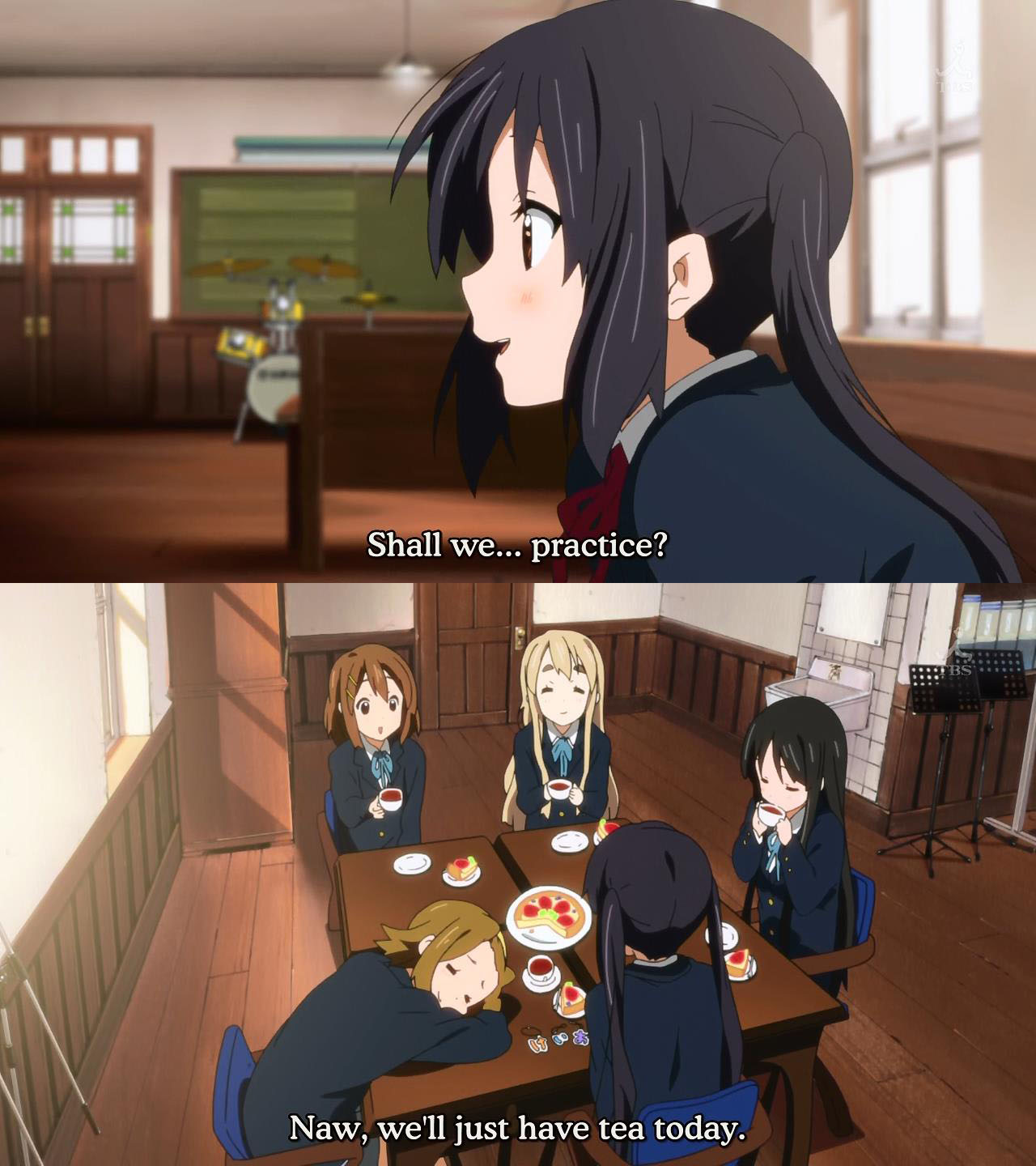
                I will start on the bad note so that I can end on the good ones.  The show does not devote itself to one specific theme in each episode.  It usually has two or three things it is trying to balance at one time.  When it tries to do too much, the show falls flat with all the jokes falling to the floor.  For example, in episode 14 the keyboard player and the drummer find each other while out shopping.  A portion of the episode devotes itself to the drummer taking the keyboardist out to the arcade.  They have fun in the various things there and enjoy spending time together.  This is one of the few times that the two characters are alone and are able to interact without the presence or interference of the others.  The part of the episode that only had the two characters includes a refreshing dynamic that the rest of the show is lacking of.  Usually, the whole band is together and there is a single and solitary group dynamic occurring.  Sadly, this part of the episode ends quickly and is replaced with a pathetic excuse afterwards.  Basically, the keyboardist wants a more physical relationship with her peers.  One hugs another frequently.  Another scolds a forth and reprimands using a light blow to the head.  The keyboardist wants to be hit on the head because she feels left out of the kind of relationship that her peers are experiencing.  While it is understandable that she feels this way, the fact that she does not identify being slapped as a negative reaction rather than a positive one makes what comes afterward so much more annoying.  She then decides that to fulfill her dream of "being slapped" she will do scatterbrained things to warrant a natural slap rather than asking her friend, the drummer, to do it.  The rest of the episode feels forced because the humor is stemming from this.  It would have been better if the episode just had her get hit and then move on with itself.

                Take episode 16 as another example.  The whole episode, the secondary guitarist is trying to get the group to practice for a change.  If this were not the umpteenth time that this joke was made, it might actually be funny.  The episode does do one thing right.  It makes the character pair off with each of the other four band members, one at a time, and has the pairs interact.  This, like episode 14, explores a number of one on one relationships that the show usually never gets the chance to touch on.  At times, the episode is heartwarming since the characters can talk about things on a more intimate level or do things that feel like exceptions to the show's norm.  However, the episode is constantly falling back to the old joke, and reality, that the band does not practice often.  

                In the last batch, there are next to no performances of the group.  There are about three strong ones where they play full songs and a few other times where they only get as far as the intro.  I think it is the least amount of performances per batch I have watched.  All it does is point out the fact that this show is not about a group of girls in a school band.  It is just not about the music, Internet.  It is not about the music at all.  Which is a real shame.

                The few times that the group performs, the show really takes off and does what it is supposed to do.  Take the final concert that the group gives at the spring festival.  The band plays three songs, two of which are actually displayed.  In between, the main guitarist talks briefly about the various characters who surround her.  When she does this, the various relationships are highlighted to the point where the audience gains in insight to the character's specific feelings regarding to her friends.  They are touching moments because they reveal something that the show normally skips over or downplays for humor.  The graduation episode does this as well.  By not trying to be a humorous episode and instead focus on the emotional aspects of the show, it makes for better viewing since it does a much better job.  There were a few times that the show made me laugh, but those were here and there to the point of being at the same frequency of comedic relief found in dramatic stories.  I still do not think of this show as being a comedy because it fails in that regards, but there are a few moments here are there that marks it as a slice of life.

                Those moments are far apart, too far to make me recommend the show to someone.  However, in the last stretch, the show does an OK to good job of making heartwarming moments.   This might be because the show took a long enough chunk of time out of me to get used to the characters.  They are sort of like that weird uncle that the family tries to ignore at reunions.  No one really interacts with him, and he does not interact with him.  The kids like him well enough but only after gathering enough courage to talk to him.  You would miss him if he did not make it to the gathering, but you might not realize it until he actually does not come.  That is when you realize he had been taking care of all the kids the entire time and allowed you to talk to everyone else without the kids pulling at your skirt/pant leg.  Yeah, the characters in "K-On!!" are like that.  They grow on you after a while because they are there to grow.  

                At the end of the day, "K-On!!" is an average anime that has its good points too late and too far apart.  It is like getting a chocolate candy that is wrapped in ten layers of wax paper.  The wax paper is taped over at each layer, too.  Not to mention that you do not have a knife and you just cut your nails down.  Eventually you will get to the center and find something enjoyable, but it will not be filling after all the work it took to get there.  If the show had more musical segments and played up the slice of life moments than try to inject humor where it failed to do so, it would have been much better.  But all the "if"s of the world cannot play a stanza of music.

Yours in digital,
BeepBoop

P.S. Next is "Brick" (2005).

Thursday, August 1, 2013

Enty 100: "K-On!!" Ep. 1-13


The extra capitalization adds even more emphasis.

Dear Internet,

                Well, here I go.  This will be my one hundredth review.  It is somewhat a shame that I have to spend it on a show like "K-On!!", but what can I do about it?  The first review was on a copycat King Kong film, so I really should not try and make this little experiment any more glamorous that it really is.  This whole thing is just an attempt for me to keep my sanity together.  There are a few other reasons, but those are frivolous.  And I think that explains "K-On!!" pretty well.  It is a show that tests my sanity more than anything else.  It makes me laugh a few times, but those are few and far between.  This is sadder considering that it bills itself as a comedy and slice of life show.

                "K-On!!" is the second season of the first show, but it is a second production show from a technical standpoint.  You can tell this is the situation since there are two exclamation points in the title.  Do not think that it means that the show is twice as exciting.  Do not think it means that the show is twice as energetic.  Do not think it means the twice as funny.  If anything, the extra exclamation point means that the show got a little more of a budget.  Either that or it is evidence that the show is trying too hard, like reading forum posts made by middle school kids.  I suspect that if the show got another season after this it would be titled "K-On!?!"  At least then it would reflect the show's questionable ability to entertain.

                The second season picks up right where the first left off, not that the first season left us at a cliffhanger.  The closest thing to a wonder that the show could instill was what kind of food the girls were going to eat next.  This is something that boggles my mind.  The cast spends more time eating than practicing music.  At the rate that the group consumes sugary sweets and other edible confections, they should all have gained twice as much body mass at this point.  The only one that gets a free ride against this is the drummer since it is the most active instrument being played.  The main guitarist is said to never gain any weight, but that is more of an escape rather than an explanation as to how the characters regularly consume half of their diet from the cake bar.  But I digress.  

                The show is the same story from the first one, just going at a slower pace.  In thirteen episodes, the first season covered two years of high school.  In the first half of the second season, only one year passes.  With that stretched out time frame, the show does a few things differently.  It is not much but I will give the show its due.  The one difference is that there is a bit more emphasis on the musical aspects of the show, something that the first season flaked out too much on.  The show still has as one of its half dozen core jokes being that the group never seems to practice their music.  However, in the thirteen episodes toad, there were nearly twice as many performances from either the main band or from some other group.  On top of that, the show did spend an entire episode on the problems of humidity and moisture in relation to its effects on fine tuned instruments.  It did this with the backdrop of a rainy day episode, but at least it actually talked about the instruments for a change.  The show still threw it out the window when the characters started to become overly attached to their instruments.  I am talking about naming their instruments and treating them like people.  It comes across less like a joke and more like a disturbing episode from a relapsing mental patient.  Maybe this is because the straight man character, the bassist, succumbs to the same blob of a personality that the rest are already a part of.

                Perhaps I am looking at this show incorrectly.  Perhaps I am looking at it as though it is supposed to be something it is not.  Maybe instead of expecting the show to be about music and the various intricacies that come with it, I should look at it instead as a slice of life show.  Except, the show fails in that regard as well.  A slice of life show is supposed to be about nothing in particular and be about a specific thing at the same time.  Look at a show like "Usagi Drop."  The show is specifically about a man who has to take in his grandfather's child as his own, but the show as a whole is about the various troubles and blessings that come with having to raise a child.  The skill of "Usagi Drop" comes from the topics that the episode centers on.  Whether it be on learning to take care of a person besides yourself or having to change one's career for the sake of another, the slice of life genre deals with the little things of life that are in actuality the big things.  "K-On!!" does next to none of this.  There is an occasional aspect of an episode that deals with the mundane aspects of life, but it never touches upon the profoundness of that monotony.  

                A slice of life knows how to show the grandeur of the simple things in life.  A shower of rain becomes an outdoor bath.  A snail traveling across the leaf no longer becomes a garden pest, but a new pet.  A trip to the grocery store becomes an adventure into the unknown.  Taking the garbage to the curb in the middle of the night becomes a test of bravery.  A lazy afternoon becomes a display of the benefits of being lazy.  But no matter what, it has to be entertaining to the audience.  If the show does not make the viewer see these things but only gets the characters to do such, it fails as a slice of life show.  "K-On!!" has a few moments of these displays of everyday life turned extraordinary.  A cleaning of a closet becomes an expedition of buried treasure.  A summer afternoon filled with daydreams shows how close their reality is to fantasy, and so on.  The problem is that the show does not make theme moments magical.  It makes them comical, which is not really a problem if it were not for the fact that it does not do this very well.  It sets up the slice of life situation, works it a bit into a wonder, and delivers a less than average joke about it.
Why she keeps hoping the answer will change is beyond me.

                The jokes of the show can mostly be listed as such:  The main guitarist is a scatterbrained, unmotivated airhead.  The bassist reacts overly to scary things.  The drummer is an annoying git who skirts her responsibilities.  The keyboard player is rich.  The teacher is a mature adult except she is not.  The main guitarist's younger sister acts more like a mother than a younger sibling.  The secondary guitarist calls out the group for not practicing until they appease her with sweets.  They all will do anything for that white drug, sugar.  And they do not have enough common sense to function most times, yet alone learn how to play an instrument.  That is the sum of the majority of the jokes in the show.  They are funny in the first five times or so, but the show has such a small bag of tricks that it shows very quickly.  Even when it falls back on this bag of tricks, it does not use much variety when executing these jokes.

                Overall, "K-On!!" is more of the same.  It is supposed to be, considering that it is the second season.  But does that mean it has to be so much of the same?  Even the slight variety of the episodes in season two could not make the show feel like it is repeating itself.  The show had a much larger change in scenery from one episode to the next, yet it constantly felt like the circle it was traveling in was shrinking.  Not even the revival of the old light music club's band, Death Devil, could save this show.  At least I only have one more day of this.

Yours in digital,
BeepBoop